
Norwegian Newspapers on iPad: Try Again
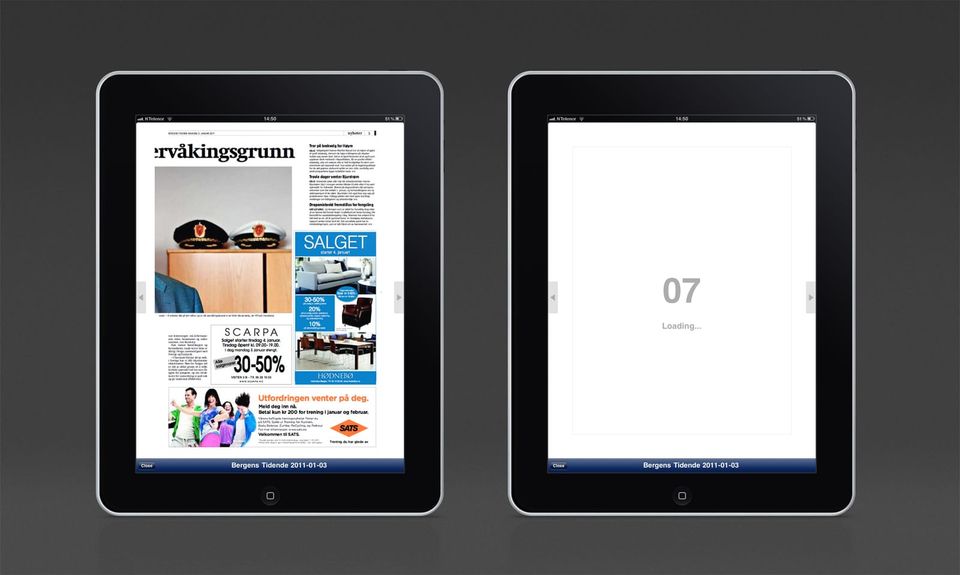
This is a translated version of the NRKBeta blog post me and Geir Arne Brevik wrote back in 2011, not long after the iPad launch. It reached a wide audience and sparked strong engagement, and I've included it here for historical purposes.
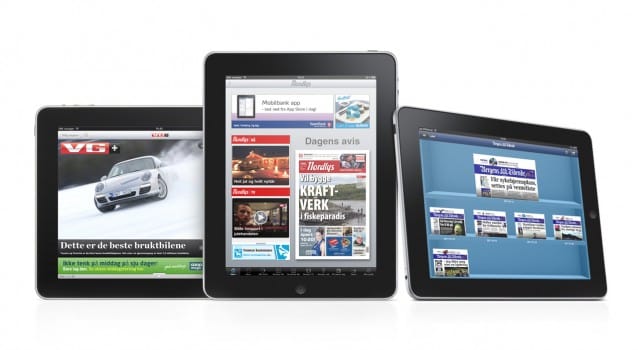
Media companies has set their eyes on the iPad, and tablets are being portrayed as the salvation of an industry in rough waters. Several Norwegian newspapers, including VG, Nordlys, and Bergens Tidende, have launched their own applications, and more will follow shortly.
It’s therefore disappointing to see that, in their ambitious pursuit of the future, they’ve overlooked what people are already used to today.
Since the internet turned the newspaper world upside down, the media industry has been searching for alternatives that can bring in real money as circulation keeps declining. Advertising revenue has proven insufficient, and pessimism has been widespread.
Since the launch of the iPad, however, there has been a certain sense of optimism. A new and fantastic tablet, backed by a well-established store that in under three years has paid out over one billion dollars to iPhone developers. Finally, newspapers will be able to charge for the content they produce. Or will they?
Practical limitations or bad metaphors?
Large parts of the newspaper world are still organized around the practical and physical characteristics tied to the production of print newspapers. But in electronic media – where cellulose, trucks, and acne-ridden paperboys are out of the equation – things like “editions” and “pages” become mere metaphors.
That’s why it’s unfortunate to see that newspaper iPad versions are built around exactly these metaphors. It almost seems as if they’ve forgotten everything they’ve learned on the web over the past 10–15 years.
VG, known for being among the fastest news providers online, chooses to deliver news on iPad only twice a day. When the suicide bombing in Stockholm occurred just before Christmas, readers had to wait until the next day to read about it in VG+. This is not the future of news delivery, it’s the past.
A typical article on nordlys.no includes a comment section, sharing options on Facebook, and related articles (cross-linking)—in addition to the browser’s capabilities like bookmarking, copying (quoting) text, and emailing links to friends. In Nordlys for iPad, however, none of these features exist.
Bergens Tidende has gone the furthest in emulating the print newspaper—they’ve simply taken a PDF of the print edition, wrapped it in an app, and charge 21 kroner per issue. Bold, considering the reading experience isn’t adapted to the screen at all. You have to scroll both horizontally and vertically, the typography looks poor, and nothing is clickable—not even the ads.
A reality check
People no longer read just one or two newspapers. They read a bit from many, they read online, and no one is interested in subscribing to a newspaper just to read a single article—especially not if they have to install an app first.
The reality is that Norwegian iPad newspapers, as we’ve seen them, don’t make their content more accessible—in fact, they drastically reduce the number of entry points to their articles. Even if it’s technically possible to solve linking (and thus Facebook sharing) in newspaper apps, it would still require that readers have a) a device capable of running the app, and b) the app installed. That makes social sharing practically impossible. At a time when the web is becoming increasingly social, this is a major weakness. By excluding sharing, you not only harm the user experience—you also limit the product’s ability to spread itself.
A failure of form
When investing so heavily in a new platform, it’s disappointing to see such a lack of care in presentation. VG+ makes an attempt, but the other iPad newspapers simply push the print edition into PDF format and/or rigid templates.
This goes against both the iPad’s vast potential for engaging presentation and the long-standing Norwegian tradition of high-quality typography and design in print newspapers. What’s needed is both professional respect for screen design and a curiosity to explore its possibilities.
Back to the drawing board?
Norwegian newspaper iPad apps are, in short, products that update too infrequently, lack social features, limit accessibility, and still have a long way to go in presentation. These are qualities that make it hard for people to love the product, and even harder to have them pay for it. So what could have been done differently?
Everyone on the internet has a browser—whether they’re using a ten-year-old Windows PC, a brand-new iPad, or a tablet from another manufacturer. Browsers exist across all platforms, and they are becoming increasingly sophisticated.
So it makes perfect sense to build on what already exists: a website. It’s entirely possible to create iPad-optimized websites (see New York Times Chrome or Zeit Online), with tailored ads, better typography than the standard web edition, integrated touch gestures, social features, more and better images—and without Apple acting as editor-in-chief (and taking 30% of the revenue).
What you don’t get is Apple’s payment system. So you have to look for money elsewhere. If the quality of today’s online newspaper product were improved, could the value of advertising also increase? Or could one rethink paywalls entirely—perhaps even create a Spotify for newspapers? 100 kroner ($10) a month for access to all content from all Norwegian newspapers?
Another approach might be to take a step back and rethink what it means to be a news provider. Media companies have always done more than just write articles—they sit on vast amounts of data, from sports and politics to culture, weather, classifieds, and more. This offers many strong starting points for creating services that are well-suited—perhaps even best suited—for apps.
TV 2 has packed its sports app with data from football matches, something that should inspire other football-obsessed editorial teams. And one service we’d love to see revived in app form is Adresseavisen’s overview of parliamentary representatives’ activity levels.
There are surely many other—and better—ideas out there waiting to be realized, ideas that could generate revenue for media companies. But we suspect these ideas share one thing in common: they don’t look back to the days when newspapers were made of paper.
It’s time to stop talking about the iPad as the device of the future—it has long since become part of the present. What remains is for the Norwegian media industry to prove it.